Here's a great article from the New York Times on the latest lending crisis...who said there isn't a welfare for the rich?
The Fed’s Subprime Solution
By JAMES GRANT
Published: August 26, 2007
THE subprime mortgage crisis of 2007 is, in fact, a credit crisis — a worldwide disruption in lending and borrowing. It is only the latest in a long succession of such disturbances. Who’s to blame? The human race, first and foremost. Well-intended public policy, second. And Wall Street, third — if only for taking what generations of policy makers have so unwisely handed it.
Possibly, one lender and one borrower could do business together without harm to themselves or to the economy around them. But masses of lenders and borrowers invariably seem to come to grief, as they have today — not only in mortgages but also in a variety of other debt instruments. First, they overdo it until the signs of excess become too obvious to ignore. Then, with contrite and fearful hearts, they proceed to underdo it. Such is the “credit cycle,” the eternal migration of lenders and borrowers between the extreme points of accommodation and stringency.
Significantly, such cycles have occurred in every institutional, monetary and regulatory setting. No need for a central bank, or for newfangled mortgage securities, or for the proliferation of hedge funds to foment a panic — there have been plenty of dislocations without any of the modern-day improvements.
Late in the 1880s, long before the institution of the Federal Reserve, Eastern savers and Western borrowers teamed up to inflate the value of cropland in the Great Plains. Gimmicky mortgages — pay interest and only interest for the first two years! — and loose talk of a new era in rainfall beguiled the borrowers. High yields on Western mortgages enticed the lenders. But the climate of Kansas and Nebraska reverted to parched, and the drought-stricken debtors trudged back East or to the West Coast in wagons emblazoned, “In God we trusted, in Kansas we busted.” To the creditors went the farms.
Every crackup is the same, yet every one is different. Today’s troubles are unusual not because the losses have been felt so far from the corner of Broad and Wall, or because our lenders are unprecedentedly reckless. The panics of the second half of the 19th century were trans-Atlantic affairs, while the debt abuses of the 1920s anticipated the most dubious lending practices of 2006. Our crisis will go down in history for different reasons.
One is the sheer size of the debt in which people have belatedly lost faith. The issuance of one kind of mortgage-backed structure — collateralized debt obligations — alone runs to $1 trillion. The shocking fragility of recently issued debt is another singular feature of the 2007 downturn — alarming numbers of defaults despite high employment and reasonably strong economic growth. Hundreds of billions of dollars of mortgage-backed securities would, by now, have had to be recalled if Wall Street did business as Detroit does.
Benjamin Graham and David L. Dodd, in the 1940 edition of their seminal volume “Security Analysis,” held that the acid test of a bond or a mortgage issuer is its ability to discharge its financial obligations “under conditions of depression rather than prosperity.” Today’s mortgage market can’t seem to weather prosperity.
A third remarkable aspect of the summer’s troubles is the speed with which the world’s central banks have felt it necessary to intervene. Bear in mind that when the Federal Reserve cut its discount rate on Aug. 17 — a move intended to restore confidence and restart the machinery of lending and borrowing — the Dow Jones industrial average had fallen just 8.25 percent from its record high. The Fed has so far refused to reduce the federal funds rate, the main interest rate it fixes, but it has all but begged the banks to avail themselves of the dollars they need through the slightly unconventional means of borrowing at the discount window — that is, from the Fed itself.
What could account for the weakness of our credit markets? Why does the Fed feel the need to intervene at the drop of a market? The reasons have to do with an idea set firmly in place in the 1930s and expanded at every crisis up to the present. This is the notion that, while the risks inherent in the business of lending and borrowing should be finally borne by the public, the profits of that line of work should mainly accrue to the lenders and borrowers.
It has not been lost on our Wall Street titans that the government is the reliable first responder to scenes of financial distress, or that there will always be enough paper dollars to go around to assist the very largest financial institutions. In the aftermath of the failure of Long-Term Capital Management, the genius-directed hedge fund that came a cropper in 1998, the Fed — under Alan Greenspan — delivered three quick reductions in the federal funds rate. Thus fortified, lenders and borrowers, speculators and investors, resumed their manic buying of technology stocks. That bubble burst in March 2000.
Understandably, it’s only the selling kind of panic to which the government dispatches its rescue apparatus. Few object to riots on the upside. But bull markets, too, go to extremes. People get carried away, prices go too high and economic resources go where they shouldn’t. Bear markets are nature’s way of returning to the rule of reason.
But the regulatory history of the past decade is the story of governmental encroachment on the bears’ habitat. Under Mr. Greenspan, the Fed set its face against falling prices everywhere. As it intervened to save the financial markets in 1998, so it printed money in 2002 and 2003 to rescue the economy. From what? From the peril of everyday lower prices — “deflation,” the economists styled it. In this mission, at least, the Fed succeeded. Prices, especially housing prices, soared. Knowing that the Fed would do its best to engineer rising prices, people responded rationally. They borrowed lots of money at the Fed’s ultralow interest rates.
Now comes the bill for that binge and, with it, cries for even greater federal oversight and protection. Ben S. Bernanke, Mr. Greenspan’s successor at the Fed (and his loyal supporter during the antideflation hysteria), is said to be resisting the demand for broadly lower interest rates. Maybe he is seeing the light that capitalism without financial failure is not capitalism at all, but a kind of socialism for the rich.
In any case, to all of us, rich and poor alike, the Fed owes a pledge that it will do what it can and not do what it can’t. High on the list of things that no human agency can, or should, attempt is manipulating prices to achieve a more stable and prosperous economy. Jiggling its interest rate, the Fed can impose the appearance of stability today, but only at the cost of instability tomorrow. By the looks of things, tomorrow is upon us already.
A century ago, on the eve of the Panic of 1907, the president of the National City Bank of New York, James Stillman, prepared for the troubles he saw coming. “If by able and judicious management,” he briefed his staff, “we have money to help our dealers when trust companies have [failed], we will have all the business we want for many years.” The panic came and his bank, today called Citigroup, emerged more profitable than ever.
Last month, Stillman’s corporate descendant, Chuck Prince, chief executive of Citigroup, dismissed fears about an early end to the postmillennial debt frolics. “When the music stops,” he told The Financial Times, “in terms of liquidity, things will get complicated. But as long as the music is playing, you’ve got to get up and dance. We’re still dancing.”
What a difference a century makes.
Sunday, August 26, 2007


Friday, August 17, 2007
Thus spake Stephen Wright

Long ago, in the 80's, a prophet foretold the coming of One whose beauty he himself could not have held a candle to...like the prophets of old, his words were ascribed to a King, but the secret meaning was clear: a child was born, and they called him Handsome. The year of my birth Stephen Wright spake thus of Steven Morrissey:
"I repeat. The only thing to be in 1983 is handsome."
Christianity
Everyone knows Jeff Buckley's rendition of Leonard Cohen's "Hallelujah." But have you ever considered it as a symbol of a Christianity that has the potential of actually working, of achieving a deep authenticity in this age of shallow, feckless religion.
What's great about Buckley's Christianity, if you will, is that it isn't. It is religionless. Heterodox. Honest. Passionate. Searching. Doubtful. Full of transcendent pathos.
Wednesday, August 15, 2007
What is a Child?

Is a child a child only when he behaves? If a child makes a big mistake, does he lose the right to continue as a child? What happens when he grows up and realizes, in the light that maturation provides, the errors of his puerile ways? If he never has the chance to benefit from that growing up because he has already been stripped of his childhood, then what hope does that man have left?
I re-entered a courtroom for the first time in five years this last week...I was attending the trial of a 14 year old boy being prosecuted as an adult, direct filed into the adult system, facing life in prison.I was that child not so many years ago...sitting in that chair, the chair of the accused, legs and arms shackled to my waist. Deja vu. Now I was watching it repeat all over again.
And yet...the other child. The child for whom society, in its infinite wisdom, considers it justice to sacrifice this child's life in propitiation for the loss of his own. Lex Talionis (the law of the talon) is still alive and well in our hearts, it seems.
The challenge is not to let oneself be ruled by fear. Not to let oneself be ruled by distorted fearmongering. And to let oneself see the child in the child. To see that child in this child. This child in that child. Until we can achieve that level of imagination, of trans-empathy, of grace, we are lost, and because we are lost our children are lost, especially when they make devastating mistakes.
If anyone cares, here is a link to the most recent coverage of the trial:
http://independent.com/news/2007/aug/09/pathologist-describes-stabbing-juarez-prelim/
Friday, June 22, 2007
My Candidate for President

So, I have been researching Presidential candidates lately. It was a tough choice--I mean, come on, what with Clinton and Obama, McCain and Giuliani, sheesh, who can choose just one!
So I have chosen a compromise candidate. Perhaps you don't recognize him. That's OK, its not your fault, he's French. Nevertheless, apart from that one little problem, he seems to be the perfect admixture between what I'd want as a President--and what everyone else seems to want in one, namely:
What People Want
1--to be rich.
2--good looking (nice hair)
3--self-possessed ("confident")
4--seemingly competent (Levy is perhaps a bit too competent. I can just see his speech writers now, wearily chiseling down his famously voluminous, long-winded, magniloquent lectures/speeches to their bare bones--so as to become intelligible to an ever linguistically degenerating American public)
5--Presumptuous
6--Seemingly visionary
What I Want
1--to be so rich she/he has ceased to be at all motivated by profit.
2--actually competent and literate, so as to be a challenging mind to follow.
3--honest to the point of offense.
4--an idiosyncratic visionary that dreams her/his own dreams.
5--rational...that is, has the capacity to understand the impact of his decisions on the least of the humans under her/his leadership.
So I choose Bernard Henri-Levy because he fits both bills fully and precisely. We'll see--my hope is that Schwarzenegger will make a push to change the Constitutional prohibition on foreign born candidates for President, and that Levy will then jump on the band wagon, fight a blitzkrieg campaign, and take the field--with consultation help from Ralph Nader--as an independent. Yeah.
bhl for President! Vive la America! (my French is horrible!)
Tuesday, June 19, 2007
Good Marketing

If there were more advertisements like this in America, then I'd think about sticking around...
Monday, June 18, 2007
Heartburn
It's just after four in the morning and I am up with heartburn. When it gets this bad, sleep is simply not an option. Having heartburn in a locked jail cell in the middle of the night, with no prospect of getting relief until the morning, was perhaps the worst experience of my entire incarceration. It was complete torture. Gagging myself was the only option--but that was only a temporary cure that made the acid come back with a vengeance in the long run.
I am also up thinking about the woman who died yesterday in a car accident right outside my Church. I had just finished speaking before the entire congregation, when the all-too-familiar screeching of tires and crunching of metal came crashing through our ears. I rushed outside along with a cadre of other church-goers to see what had happened. She was hunched over the steering wheel with blood coming out of her mouth and ears.
Would we all be paralyzed by life if all of the suffering in the world happened right outside our Church windows? Is proximity the only thing that keeps us from feeling the true depth of human sorrow? Seeing is feeling. Not seeing, well...And we are excused if we do not see...and yet, what if we have missed the main part of the suffering in the world because we have in reality averted our eyes from it and erected walls against it?
And if we gag ourselves to find a moments respite from the pain...rather than find a real solution, then will it in the end come back to us with a vengeance?
I am also up thinking about the woman who died yesterday in a car accident right outside my Church. I had just finished speaking before the entire congregation, when the all-too-familiar screeching of tires and crunching of metal came crashing through our ears. I rushed outside along with a cadre of other church-goers to see what had happened. She was hunched over the steering wheel with blood coming out of her mouth and ears.
Would we all be paralyzed by life if all of the suffering in the world happened right outside our Church windows? Is proximity the only thing that keeps us from feeling the true depth of human sorrow? Seeing is feeling. Not seeing, well...And we are excused if we do not see...and yet, what if we have missed the main part of the suffering in the world because we have in reality averted our eyes from it and erected walls against it?
And if we gag ourselves to find a moments respite from the pain...rather than find a real solution, then will it in the end come back to us with a vengeance?
Friday, June 15, 2007
Happy Animality

I have been in the thick of writing my senior thesis--The End of Liberty--well, actually, in the thick of trying to find the time to write it...anyway, in the course of my research I came across this picture of a sculpture ("The Young Family") by Australian sculpter Patricia Piccinini, which, although meant to depict a transgenic creature representing the biological "animalness" in humans, is in my mind a representation as well of the "animalness" (or potential animalness) of our non-physical identities. Could it be that our thoughts, our thought-worlds, our social organizations, are in fact shot through with animality on some very basic biological level? The point is mundane if taken in its simplest sense that we are, afterall mere mammals. And if we are in a very basic psycho-social sense animal, then what can this potentially say, for example, about some of our most cherished and enlightened ideas? Such as liberty. Such as equality. Such as democracy. Such as tolerance. The point I am trying to make in my thesis is not actually this point--but the more I study the more I realize that, even if we are much more than highly developed mammals (which I believe), I think that the state of the world makes a strong argument for the fact that human beings, under the guise of enlightened development and 'progress', are in fact becoming more animal-like everyday. Most importantly, we are becoming animal in the sense that we are losing our seemingly instinctive and distinctively human drive to self-reflect and critically engage the world as it is. In the course of this regress, I fear, we are losing the very freedom, the freedom to self-determine by critically engaging the world as a uniquely valuable and autonomous individual, that makes us most special as human beings--whatever, in the final analysis we happent to actually be.
Wednesday, June 13, 2007
More musings on freedom


Freedom. It can either be negative or positive. There is, at least with respect to the idea if not the reality, this choice.
So I am reading Isaiah Berlin, but I am also at the same time reading Hannah Arendt. They are fighting an epic battle in my head. The irony is that both Arendt and Berlin think that freedom is sacred for radically different reasons--rather, Arendt's passion is for a critical freedom, a freedom that is truly opposed to external positivity. Berlin, however, seems in the end to be a lover of the freedom that is.
Berlin and Arendt hated eachother--or in any case Berlin hated Arendt. This makes sense, considering their different approaches and final evaluations, really, of the march of freedom in the world.
In the end, I think their difference is in fact the most important difference within the liberal tradition--where to hang ones hat in terms of moral judgment. Berlin saw Arendt's judgment as fundamentally flawed because it lacked pity. Arendt certainly would have seen Berlin's appeal to pity as compromising a truly honest evaluation of the world. Berlin's judgment was a judgment informed by liberal principles of thought, like Arendt's, but with this fundamental difference--he accepted liberal democracy into his soul. I don't think that Arendt ever went as far. She certainly considered liberal democracy as the best system of government available, and as such morally legitimate, especially since it protected fundamental human rights. Nevertheless, it never became for her the internal structure of her soul as it did for Berlin. Michael Ignatieff notes that Berlin saw himself as "a cosy Russian tea-drinking Jew" and Arendt as "the qunitessential Yekke, the punctilious, exacting and charmless German Jew." Better: Berlin was content with the world he had escaped to and loved it as an end-in-itself; while Arendt appreciated the world she escaped to, but loved it enough to keep it brutally, painfully honest and growing.
Sunday, June 10, 2007
Berlin and Me

I am reading the works of Isaiah Berlin at the moment. I began rereading his famed essay "Two Concepts of Liberty" last night in the bath. I really understand him. It is one thing to follow a phiosopher's arguments--to grasp what he is saying, to place his thought within the history of ideas, etc. But it its quite another thing to truly understand one. To understand a philosopher is to find that there is a part of one's own perspective that squares with his own. It is to recognize affinity, a kind of unity of vision. Nevertheless, this is a troubling thing for me because I am reasonably sure that Berlin has been rather misused in the history of ideas. Because he argued for a prevailing philosophical understanding of the world in a time when this understanding was acheiving fame and success in the social and political world wherein he lived and thought (in contrast, for example, to the New Left, whose philosophy, while popular and deriving force from the socialist/communist world, was nevertheless a critical, oppositional philosophy), his insights have been cheapened and streamlined in order to reflect the state of the world as is. My commitment, aboveall, is to change the present state of the world--and yet here I am looking into the soul of Isaiah Berlin and fnding a part of my own there.
Obviously, I can simply claim that Berlin is misunderstood. But that would be dishonest. In a real sense Berlin was a proponent of the liberal-democractic world of which I remain at best a skeptical critic. However, in a real way I need Berlin to remain a good skeptic, a critic committed to building up rather than simply tearing down. I really think that intellectual maturity consists in the simple ability to read and to understand disparate intellectual traditions, and to begin to think their concepts at the same time.
Sunday, June 03, 2007
A Note to Self

A week ago I was sitting in a cell. Two days ago I was riding on this bicycle with Mer. Today...
Saturday, June 02, 2007
Back in the USSR

In June of 1976 the Beatles released "Back in the USSR," a parody of Chuck Berry's tune, as well as of the Beach Boys, but actually referring to a particularly bad flight the band took from Russia back to Britain. When I was working at a sheet metal shop in prison I used to hear it a lot on the radio for some reason. Ironically, I have frequently described to people asking me what prison is like by drawing an analogy between the Soviet system and the prison facility.
Prison has it all--the Gulag, Big Brother, a tight, centralized, top-down, authoritarian government, a strictly regulated economy and repressive social and cultural system, as well as a thriving black market. It is also bleak and metallic ("Stalin" means "Steel"), homogenous and sparse--the product of an idolizaiton of sheer, raw power at it's most explicit.
Most of the time, responding to my friend's questions, I felt sort of like George Kennan, writing my long telegrams from this totally alien place, grasping for analogies that a member of the "free world" would understand.
Because it is not until one has lived in a totalitarian-authoritarian system that one fully understands it. Not until it begins to work on your identity, eroding away one's intrinsic sense of individual significance, that one begins to grasp the gravity of what it means to be controlled by a system.
When I got out I felt agoraphobic for a week. Men in black suits, or Crown Victorias were under-cover police folloowing me, waiting for me to slip up. Although these feelings were brief, and I immediately recognized them as silly and irrational--the fact remains that I actually experienced them. What were perfectly normal reactions in prison were silly and irrational in the "free world." This has been both profound and disturbing at the same time.
Coming back into the world of "freedom" has been an immense shock. More shocking however, for me, has been the realization of how consensual I had been to the state of the world before I was so abruptly rended from it.
Thursday, May 31, 2007
An Occasional Glimmer of Light
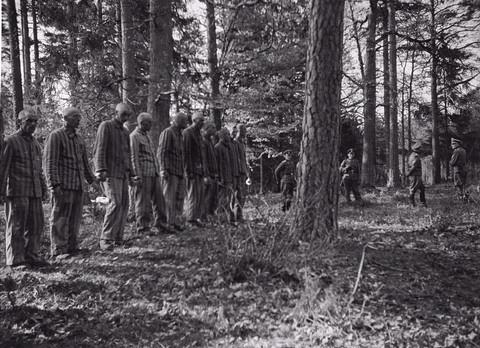
On 28 December 1944, Dietrich Bonhoffer was permitted to write his mother a letter from his prison cell at the Gestapo prison on Prince-Albrecht-Strasse. He told her he had to write quickly, as the post was about to go out.
"Dear Mother, I want you to know that I am constantly thinking of you and Father every day, and that I thank God for all that you are to me and the whole family. I know you have always lived for us and have not lived a life of your own. That is why you are the only one with whom I can share all that I am going through...Thank you for all the love that has come to me in my cell from you during the past year, and has made every day easier for me...My wish for you and Father...and for us all is that the New Year may bring us at least an occasional glimmer of light, and that we may once more have the joy of being together."
There are some, in the inscrutible will of God, who are vouchsafed those occasional glimmerings of light, and those who are not. I remember first reading these beautiful and simple words of Bonhoffer to his dear Mother in juvenile hall, then again in County Jail, and again in prison. They have always meant much more to me than a simple expression of a son's maternal devotion. They resonate in my soul in a special way that I have never really been able to come to terms with.
I wrote a letter the day before my release, a release which was by no means certain, wherein I tried to express what those glimmerings have taught me over my long captivity:
"My hand trembles as I write. The anticipation, the longing, the fear. I pour my soul out to God this night--in gratitude as much as in supplication. I had this realization today--it fell out of the sky. Blessing amidst the pain. Joy in the midst of sorrow. Today, tonight, this last night, the words are all gone. I am rendered speechless by His Face. He has been teaching me this moment, what it means to love as He loves. The love of God--as simple as that. To live amongst, share the plight of, the very life of, the unlovable, in order to see wahat love means and how it feels in His eyes, in His heart...in the Dark Face of God there is joy, limitless joy..."
The ecstasy of light. Light swallowed up by the Dark Face of God. Why me? Why have I been spared? Why am I spared while others are sacrificed to Evil?
The depth of this question...so deep it threatens to swallow the light from those glimmerings that have ignited my soul and have kept it burning through a very dark night indeed.
Friday, February 09, 2007
Disorder
Prison authorities call it maintaining accountability consistent with a structured environment. This defines prison—the perpetual prevention and suppression of disorder.
“The leper and his separation; the plague and its separations. The first is marked; the second analyzed and distributed. The exile of the leper and the arrest of the plague do not bring with them the same political dream. The first is that of a pure community, the second that of a disciplined society. Two ways of exercising power over men, of controlling their relations, of separating out their dangerous mixtures. The plague-stricken town, traversed throughout with hierarchy, surveillance, observation, writing; the town immobilized by the functioning of an extensive power that bears in a distinct way over all individual bodies—this is the utopia of the perfectly governed city.”
It is fashionable to call prisons, ghettos, and anything blighted or depressed areas of social exclusion. But exclusion implies a throwing away, a pushing aside, but also a turning aside. It implies a kind of disregard, a removal from the map of modern knowledge and study. This is ironic, since prisons, ghettos and places of blight and depression are some of the most studied, monitored, and observed areas of society. Foucault, then, is right to call them places of social discipline. But he doesn’t make an absolute distinction. He synthesizes the two:
“to the space of exclusion of which the leper was the symbolic inhabitant (beggars, vagabonds, madmen and the disorderly formed the real population) [was applied] the technique of power proper to disciplinary partitioning. Treat ‘lepers’ as ‘plague victims’, project the subtle segmentations of discipline onto the confused space of internment, combine it with the methods of analytical distribution proper to power, individualize the excluded, but use procedures of individualization to mark exclusion—this is what was operated regularly by disciplinary power from the beginning of the nineteenth century in the psychiatric asylum, the penitentiary, the reformatory, the approved school, and, to some extent, the hospital.”
Isn’t Foucault intense? The active and passive aspects of power, of the power-ful, driven by the social fear of all forms of disorder, including, of course, criminality.
Apollonius locking down the Dionysian districts of society.
Total disorder is never good; but neither is total discipline.
Sunday, February 04, 2007
The Jungle
Quid Pro Quo
Prison culture would be fascinating if it weren’t so deeply disturbing. The shallow stereotypes don’t even begin to explain the complexity. This is not surprising, considering the long list of disincentives for social scientists or cultural anthropologists to engage in the kind of participatory studies necessary to illuminate the minute complexity at work within prison subcultures.
Prison culture is unique because it is completely synthetic. It’s a pre-fab culture, a function of the criminal justice process, its landscape and macrodynamics wholly determined by a centralized authority external to the cultural participants. The culture precedes the people. It is a little bit monastery, a little bit colony, a little bit Soviet central planning, but unique in that its unifying characteristic is what criminologists call antisociality—the cognitive-behavioral departure of the individual from the norms dictated by a given social system, enshrined in it’s code of law.
What this means, among other things, is that prison culture bears on its surface that which most other cultures keep hidden deep beneath the surface. Prison culture is the inside-out boy of cultures. The honesty begins with their formal titles: “Correctional Institutions.” The candor has never ceased to amaze me. It’s everywhere. I remember recently seeing a staff member proudly displaying his favorite California Correctional Peace Officers Association T-shirt to some of the wards under his charge. It boasted a large print on its back depicting a Panther or Cougar with large, blood red eyes, growling behind the bars of a cage. Under the picture a commentary was offered: “It’s a jungle in here.”
We, of course, are the fearsome beasts behind the cages with the blood red eyes living in the “jungle.”
Tocqueville, it will be recalled, came to
“Hey, shoot this next door dawg. Good lookin’ out.”
I take the small scrap of paper from the narrow crack in the electric door and pass it through an identical crack in an identical electrical door immediately to my left. I have just engaged in a vital cultural practice of prison life—which might be called, if anyone cared to study it, the quid pro quo system. This is a curious practice that cannot be accurately defined according to the usual scholastic stereotypes utilized to elucidate prison culture.
Let me summarize the complex dynamics underlying the practice. First of all, the note was passed from a Hispanic to a Black by way of a White ad hoc courier (these color distinctions are absolutely basic in prison). The Hispanic ward initiated the quid pro quo fully aware that his request would commit the White ward to breaking a prison law infraction, although only sporadically enforced and carrying minor repercussions. The White ward was also fully aware of the minor illegality of the favor being requested of him. But, after observing that the object to be passed was innocuous and neutral (a small drawing, probably a tattoo pattern), he calculated that, in this instance, the benefits clearly outweighed the risks. Ordinarily he would not have thought much at all about this simple task, especially had it been a neutral transfer, that is, if he had been asked to pass the object from one Hispanic to another, intra-racially.
What is interesting about the quid pro quo phenomenon is how it resembles, in an inside-out kind of way, the complex race relations that govern society in general. Whereas in prison segregation is an open secret, all but enshrined in the structure itself; in society it is no less a reality, but it is a concealed reality, an unspoken status quo.
We are deeply disturbed when we SEE the overt segregation and accompanying cultural practices in prison culture. But we slumber on in blissful disregard about the covert segregation that defines our own communities, precisely because it remains unseen.
Why? Why are we so chronically unconcerned about the “jungle” that is our own society?
Friday, December 15, 2006
Then and Now
Are youthful offenders today fundamentally different than they were 20, 30 years ago? Much ink has been spilled on this question, and many an editorialist has met a deadline with stories sensationalizing the leaner, meaner youth criminal. Neologisms have been constructed (think “supercriminal”); panels assembled; laws reinforced (think proposition 21 in 2000, or Jessica’s law in 2006). But what of it?
The question came up recently. I was engaged in a discussion with a couple of retired juvenile justice system administrators, two Latino men in their early 60’s. We were discussing the current challenges facing the reforms (a favorite subject lately), and they were rightly pointing out the two biggest obstacles facing the system: cultural resistance to change among the staff population, and ubiquitous violence among the ward population. I responded, “Yeah, but what’s new? The system has known this for years, through several reform cycles. What makes you think there are now real solutions? What in the current reforms (which are conventional enough) makes us think that the system will respond differently?”
One of these elder statesmen of system shuffled in his seat, obviously riffled, and replied thus to my admittedly dismissive objections, “What we need is respect between staff and wards. A respect initiated by the staff and reciprocated by the wards—we used to have that in the ‘70’s, but this generation of staff and wards are different. (At this point he went on a lengthy tangent about the identically immature behavior of staff and wards. “They just wear different uniforms,” he said.) There is less respect. The wards are more violent, more fearless. They don’t respect human life.”
This is a common enough perspective, despite the fact that juvenile crime has actually hit record lows in the last decade or so (though recent data indicates a rise, especially in middling cities like
I responded, “ But what’s the difference between a youth in the ‘70’s and a youth in 2006? Fundamentally, nothing…” I was immediately cut off by the other retiree, who interjected, with a wisp of aged condescension, “I personally disagree. Like my partner said, these guys are really different from the guys I dealt with thirty years ago. Drive-by shootings didn’t exist back then. You would have innocent children being killed by stray bullets back then (referring to a recent shooting that killed a three year old girl in
I never got a chance to develop my argument. But as I sat there, silenced by forced veneration, I began to question my own opinion. Have youthful offenders really evolved as criminals over the past 30 years? The system has certainly changed. It has become prisonized to a degree unimaginable in the ‘70’s, and the average ward has indeed become younger, meaner, angrier, more reckless. The streets seem to have become meaner too, more disorganized, more brutal. But has a fundamental change occurred, and if so, would we even be able to detect it?
I still think there is no fundamental change—social conditions have perhaps become more acute (think the crack baby phenom of the ‘80’s as one example, the swelling of the underclass as another); but this seems to be a quantitative change, one of degree that has not, as yet, effected a more basic change in quality. But that said, the old solutions may nonetheless be obsolete (or perhaps they always were).
Youth criminals are more intense today, expressions of a more desperate social condition, but not different. Drugs, especially hard drugs like Meth play a huge role, as do guns. These factors change the face of crime and the criminal, and raise the stakes exponentially—but they do not, or have not as yet, changed the kid.
The question we need to be asking ourselves is not the qualitative one. In fact, to go down that road, I am convinced, would be perilous. I am sure that it would lead to the dissolution of the Juvenile System altogether—something we might already be seeing (the juvenile system is now literally a mere department in the adult corrections system). In all of our discussions, we must be careful to constantly reaffirm the fundamental difference between youth and adults. That, in fact, should be above all our greatest interest.
Sunday, December 03, 2006
Over the Wall
I am looking out my small wedge-shaped window—inmate proof window, a product of the increasing specialization of prison-building developed over the course of the past 20 years. (Some have called the 20th century in
I am looking out, beyond the razor wire, at the sparkling lights on the hills, suburbs about a half-mile away. They might as well be a thousand miles away, though. I look out at them every night, and they have become painful symbols of all that I am not, all that I cannot have, all that I have been forcibly removed from.
I have a German friend that remembers peering over the wall dividing East from West Germany as a child. She remembers seeing, from time to time, women just like herself, peering back at her, bags or children in their arms, with longing and resignation in their eyes. She remembers feeling sorry for them. She understood, even as a small child, the deprivations they endured on the Eastern side of the wall, only a few yards of concrete and razor wire between them. But she too felt that short distance represented a huge existential gulf.
I am staring again now, imaging myself to be one of those women, peering back with a torn spirit—longing, yet deeply resigned (the most painful docility). Is anyone peering back at this moment, thinking about the deprivations endured on this side of the wall?
My friend has frequently spoken of that experience as formative—teaching her the brutal absurdity of man-made divisions. Perhaps it was the immediacy of her encounter, her proximity to the wall, the fact that she could see the women’s faces and read their eyes; perhaps it was this immediacy, this contact, that taught her the lesson.
Or rather, forced it upon her mind. We must never forget that we build walls, in part, to forget. To shut out. To ignore. Ignorance is blissful because it has very high walls.
Walls, in this sense, are a failure of the human spirit. We build them so that we cannot see the woman’s face, or read her eyes. If we do not see, we do not care.
Walls are necessary I guess. Yes, they’re necessary, just as long as they are not absolute. Walls can indeed be beautiful. So long as they have doorways…
Tuesday, November 28, 2006
People and Productivity
The first time I heard the phrase, I was probably in the womb, my Mother probably watching the latest criminal justice sensation story on TV. That's how immanent the concept seems to me anyway.
It is one of those phrases that slips continuously into social consciousness, an unconscious mechanism in liberal-democratic societies (a-la-Borat, read repressed) that controls widespread social panic , euphemistically addressing a society's carefully hidden doppelganger--the antisocial.
Nevertheless, it took me years of incarceration, of crossing into the forbidden territory itself, to come to a full understanding of its meaning-in-use.
It usually comes as a great rhetorical flourish ending an inspiring speech made by someone in authority. To these people, it is the last word par excellence--the essential message to the enemy, the basic Gospel to the benighted heathen, the critical freedom message of Voice of America. It is to them like the musical flourish--a twitter really--to the Baroque Symphony; like celebratory gunfire to sub-national third-world militias; like the Aaronic Benediction to the Catholic Mass.
"...so that they might become productive members of society."
There it is in all of its anti-antisocial beauty. If I could I'd embark on a great etymological dig to uncover the first use of this blessed phrase, and its first benevolent application to the benighted criminal. Like Foucault, I would excavate the historical record and find where it all began, where the public mind initially contracted its peculiar viral strain.
There is no doubt some great mystery about the whole of human society hidden in that archaeological record---a deep and all-pervasive essence that has contributed a part to the very fabric of the contemporary social system.
Reducing the role of criminal rehabilitation to social productivity reveals, apart from an all-pervasive capitalist thought-world, the cynical nature of of the current correctional regime. A productive member of society, in this view, and which is borne out by reality, can be a subsistence wage earner who never finished high school, and lives the entirety of his life in a disorganized, disadvantaged community. This is a legitimately productive rehabilitated criminal in the system's view. Productivity, thus, is exposed as a euphemism for benign underclass.
Nevermind that subsistence wages, lack of education, and underclass status are all leading factors in criminality. That's clearly not important--what's important is reducing crime!
Incredibly, the authorities do not see the connection, nor the contradiction here...
More on this later.
It is one of those phrases that slips continuously into social consciousness, an unconscious mechanism in liberal-democratic societies (a-la-Borat, read repressed) that controls widespread social panic , euphemistically addressing a society's carefully hidden doppelganger--the antisocial.
Nevertheless, it took me years of incarceration, of crossing into the forbidden territory itself, to come to a full understanding of its meaning-in-use.
It usually comes as a great rhetorical flourish ending an inspiring speech made by someone in authority. To these people, it is the last word par excellence--the essential message to the enemy, the basic Gospel to the benighted heathen, the critical freedom message of Voice of America. It is to them like the musical flourish--a twitter really--to the Baroque Symphony; like celebratory gunfire to sub-national third-world militias; like the Aaronic Benediction to the Catholic Mass.
"...so that they might become productive members of society."
There it is in all of its anti-antisocial beauty. If I could I'd embark on a great etymological dig to uncover the first use of this blessed phrase, and its first benevolent application to the benighted criminal. Like Foucault, I would excavate the historical record and find where it all began, where the public mind initially contracted its peculiar viral strain.
There is no doubt some great mystery about the whole of human society hidden in that archaeological record---a deep and all-pervasive essence that has contributed a part to the very fabric of the contemporary social system.
Reducing the role of criminal rehabilitation to social productivity reveals, apart from an all-pervasive capitalist thought-world, the cynical nature of of the current correctional regime. A productive member of society, in this view, and which is borne out by reality, can be a subsistence wage earner who never finished high school, and lives the entirety of his life in a disorganized, disadvantaged community. This is a legitimately productive rehabilitated criminal in the system's view. Productivity, thus, is exposed as a euphemism for benign underclass.
Nevermind that subsistence wages, lack of education, and underclass status are all leading factors in criminality. That's clearly not important--what's important is reducing crime!
Incredibly, the authorities do not see the connection, nor the contradiction here...
Sunday, November 26, 2006
Rule by Nobody
Hannah Arendt once defined bureaucracy thus. And she said of it, "If we identify tyrrany as government that is not held to give account of itself, rule by nobody is clearly the most tyrannical of all, since there is no one left who could even be asked to answer for what is being done." What she says next is as striking as it is relevant to the basic dynamic of prison society: "It is this state of affairs, making it impossible to localize responsibility and to identify the enemy, that is the most potent causes of the current (written in the 1960's but just as relevant today) world-wide rebellious unrest, its chaotic nature, and its dangerous tendency to get out of control and to run amuck" (Arendt in her essay "On Violence").
"I want a grievance right f--ing now!" Bang, bang, bang. "Get the grievance clerk down here now ^&5@$!" Bang, bang, bang. This is a daily routine here--the default response whenever a ward feels that he has been treated unjustly. The cards are always stacked against him of course; and I have seen an equal amount of frivolous and legitimate grievances, all following this precise pattern. Welcome to the first step in the bureaucratic process of the youth prison grievance system.
In theory, a polite and helpful staff is supposed to send a competent ward grievance clerk to deliver a numbered grievance form to the ward grievant. He is then supposed to fill out the form, and return it to the clerk who logs it and then submits it to the living unit Senior Youth Correctional Counselor. She is then supposed to exercise all of her competence and training to weigh the merits of the grievance, and deliver the preliminary finding. If the grievant is not satisfied, an appeal process is enacted that basically climbs the bureaucratic ladder of the institution.
In practice, literally anything can happen. The grievance clerk is never sent, or more frequently, he is instructed not issue the grievance. Or the grievant is offered some small pittance (I have seen anything from doughnuts to electronics) in exchange for withdrawing his request. Or the grievance gets “lost” (usually thrown away). Or perhaps its most frustrating fate, it actually makes its way along the prescribed bureaucratic track—and the grievant is patronized, the issue is evaded or ignored through the masterful use of technicalities, staff are defended, and the grievance is finally “resolved”, that is, a higher, ostensibly more competent bureaucratic official proclaims, ex officio, a last and final judgment, whether in accordance with policy or not, and the whole matter is dropped. Usually by that time the grievant is either pacified to his satisfaction, so disillusioned that he gives up with no further objection, or has further demonstrated his immaturity and “acted out”, usually violently, and the issue is therefore transformed into an issue dealing now with the wards own behavior. The buck gets passed endlessly in the process. The faces change, the only consistency being certain favored clichés, taught I think in a top secret ministry for bureaucrats deep underground---“I’m just doing my job.” Or, “I’m just following policy.” Or, “Well, you’ll have to take that issue up with my boss.” Or dozens more instantiations of the same oxymoronic expression of bureaucratic responsibility.
Prison Rule by Nobody is the leading cause, in my experience, of tension, anxiety, and violence in prisons. It underlies every other problem, taints the whole superstructure, and is therefore partially responsible for them all.
Wednesday, November 22, 2006
Forever Young
"Hey Nasty, your boy C-Loc says what's up, cuz."
"Heeey, what's my boy doin out there Capone?"
"Gang-Bangin!!"
So the conversation goes, night and day. Delusions of grandeur in the minds of socially disadvantaged, developmentally stunted young adults in the California Division of Juvenile Justice. These guys are rapidly budding into adults, at least legally and physically (state jurisdiction delays their legal development into full-fledged adults until their 25th birthday...unless of course they do something really bad).
Beyond physical and legal maturation, however, there is little or no progress. All the trappings of adolescent immaturity--the idolization of Rap stars; unrealistic delusions of impending fame and wealth; unrestrained hypersexuality; utterly self-centered notions of social expectations and responsibilities; oppositional-defiance syndrome-esque perspectives of normative modes of social participation and authority--mixed with histories of abuse, broken homes, drug abuse, delinquency, antisocial attitudes, and frequently, violent crime, reinforced by a youth prison culture that turns these characteristics into a full-blown identity.
Meet the typical ward of the California Division of Juvenile Justice.
Sometimes it amazes me that these are the same kids that California has become so frightened of. A kid that calls himself Capone (after the famous Mobster) is a gang member, but can barely read or write, sings rap songs at the top of his lungs thinking he's the next rapper-cum-entrepreneuer, and whose plan B is to somehow buy an apartment complex in Watts and "sell it for big money to Section 8."
Another who tattoos racist symbols on his arms with pen ink and a staple in his cell ("I just do it dot to dot, you know."), thinks himself a part of a neo-nazi race of ubermench, but who comes to me when nobody's looking to ask for help to pass his GED exam so that he can "get a high-power (that means really good) job when I get out."
These guys, these kids are frightening when they have a gun in their hands. Have we ever really stopped and asked why they don't even believe the hype themselves?
Living among them, being identified as one of them, I know that for most, they turn to criminality, paradoxically, because its the easiest option. Their fears are the fears of children--they don't want me because I'm too different; they think I'm stupid; I don't have what it takes. Many of these thoguhts I had when I was 6 or 7 years old.
I frequently wonder what kind of hell it is to simply lack the socio-psychological (or, as the system likes to call it, cognitive-behavioral) equipment to grow up, to think adult thoughts, to develop a truly mature sense of self. I have read about patients with severe brain trauma, who can no longer recognize the human face qua human face. Is something of the sort also the case with these eternal youth? Have they lost the ability to recognize, identify with, the face of society? What do they see when they look in the mirror? Is acquiring social norms like acquiring language--the older you get, the harder it becomes?
"Heeey, what's my boy doin out there Capone?"
"Gang-Bangin!!"
So the conversation goes, night and day. Delusions of grandeur in the minds of socially disadvantaged, developmentally stunted young adults in the California Division of Juvenile Justice. These guys are rapidly budding into adults, at least legally and physically (state jurisdiction delays their legal development into full-fledged adults until their 25th birthday...unless of course they do something really bad).
Beyond physical and legal maturation, however, there is little or no progress. All the trappings of adolescent immaturity--the idolization of Rap stars; unrealistic delusions of impending fame and wealth; unrestrained hypersexuality; utterly self-centered notions of social expectations and responsibilities; oppositional-defiance syndrome-esque perspectives of normative modes of social participation and authority--mixed with histories of abuse, broken homes, drug abuse, delinquency, antisocial attitudes, and frequently, violent crime, reinforced by a youth prison culture that turns these characteristics into a full-blown identity.
Meet the typical ward of the California Division of Juvenile Justice.
Sometimes it amazes me that these are the same kids that California has become so frightened of. A kid that calls himself Capone (after the famous Mobster) is a gang member, but can barely read or write, sings rap songs at the top of his lungs thinking he's the next rapper-cum-entrepreneuer, and whose plan B is to somehow buy an apartment complex in Watts and "sell it for big money to Section 8."
Another who tattoos racist symbols on his arms with pen ink and a staple in his cell ("I just do it dot to dot, you know."), thinks himself a part of a neo-nazi race of ubermench, but who comes to me when nobody's looking to ask for help to pass his GED exam so that he can "get a high-power (that means really good) job when I get out."
These guys, these kids are frightening when they have a gun in their hands. Have we ever really stopped and asked why they don't even believe the hype themselves?
Living among them, being identified as one of them, I know that for most, they turn to criminality, paradoxically, because its the easiest option. Their fears are the fears of children--they don't want me because I'm too different; they think I'm stupid; I don't have what it takes. Many of these thoguhts I had when I was 6 or 7 years old.
I frequently wonder what kind of hell it is to simply lack the socio-psychological (or, as the system likes to call it, cognitive-behavioral) equipment to grow up, to think adult thoughts, to develop a truly mature sense of self. I have read about patients with severe brain trauma, who can no longer recognize the human face qua human face. Is something of the sort also the case with these eternal youth? Have they lost the ability to recognize, identify with, the face of society? What do they see when they look in the mirror? Is acquiring social norms like acquiring language--the older you get, the harder it becomes?
Subscribe to:
Posts (Atom)